
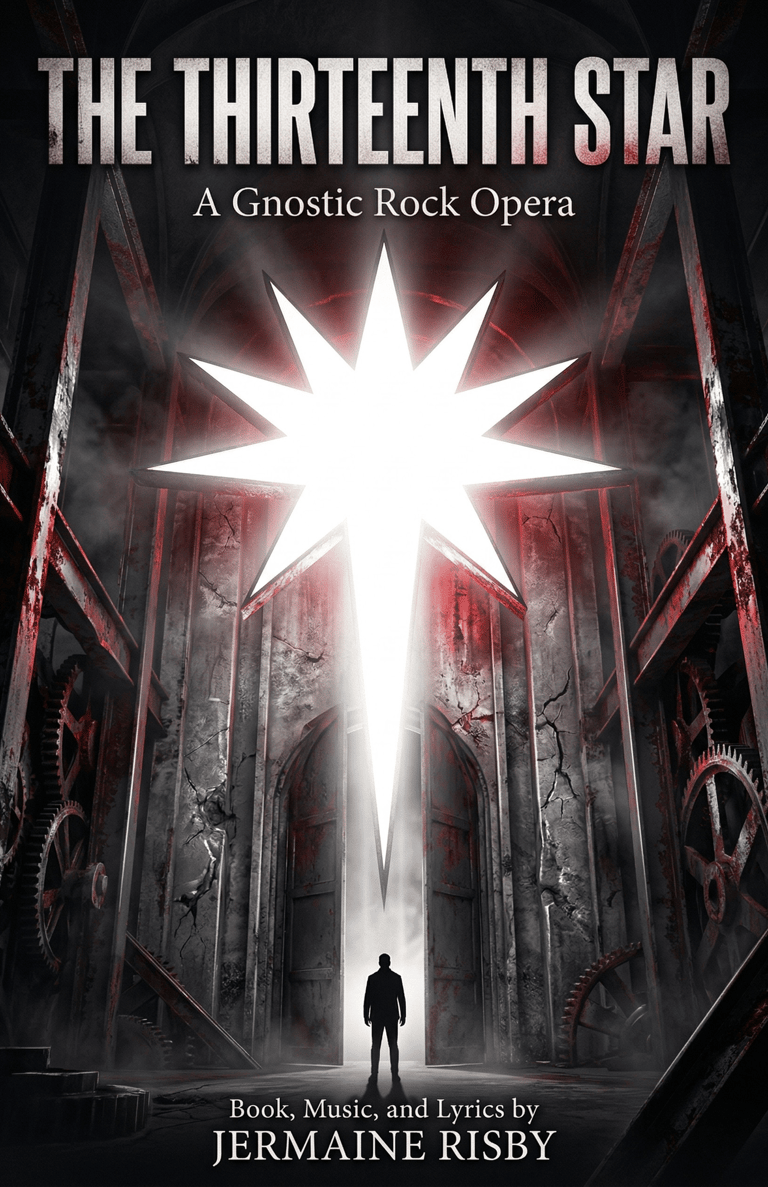
The Thirteenth Star
A Gnostic Rock Opera
The Thirteenth Star is a 2+ hour sung-through odyssey that moves from the heavy, industrial "prison" of the material world to the blinding, ethereal light of the internal spirit.
Act I: The Sacrifice of the Flesh
Narrative Source: The Gospel of Judas
Primary Focus: The Secret History of the Betrayal
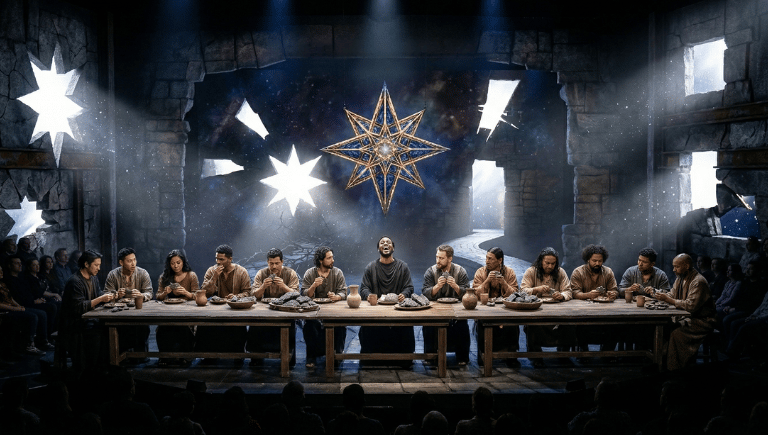
Act I is set within the Kenoma—the "Void" of physical existence. The stage is a brutalist, industrial landscape of gray salt, rusted iron, and heavy stone where the air is thick with mineral dust. Musically, the act is defined by "Sondheim Corrosion": sharp, mechanical percussion and dissonant strings that mirror the rigid laws of the material world.
The story begins at the table of "The Wrong Prayer." As the disciples perform a ritual to a god of bread and law, Jesus shatters their comfort with laughter, revealing they are worshipping the Demiurge—an ignorant architect who built a box with no door. Through the "Star’s Descent" suite, Jesus identifies Judas as the "Thirteenth Star," the only one brave enough to look past the physical form.
In a secret room where rain falls inside a wine glass, the group explores the Gnostic cosmology: the fall of the Aeon Sophia and the accidental creation of our flawed world. This revelation leads to a nightmarish vision where the disciples must confront their own roles as "priests of a prison". The act culminates in Gethsemane, among trees made of glass. In a high-octane rock finale, Judas receives his true commission: to "unbutton the flesh" of his master, performing the betrayal not as a sin, but as a sacred duty to liberate the spirit.
Act I Finale: As Judas kisses Jesus, the body begins to peel away in shimmering strips, and the glass trees shatter into a blinding, white silence.
Act II: The Ascent of the Spirit
Narrative Source: The Gospel of Mary
Primary Focus: The Schism of the Legacy
Act II opens in the Void of Loss. The industrial room has become a dystopian ruin where the disciples are paralyzed by the Shepherd’s absence. The score shifts toward "Ethereal Wave"—cascading, shimmering guitars and ritualistic, feral drumming that feels ancient and futuristic all at once.
Peter, desperate for order, attempts to "glue the salt walls" back together, his music becoming an anxious folk-rock anthem about safety and boundaries. He begins to turn into literal stone as he builds his "Rock." Into this fear walks Mary Magdalene, glowing with internal knowledge. She reveals that the Savior is not a lost body, but an enduring silence within each human heart.
The centerpiece of the show is Mary’s 20-minute musical suite: The Ascent of the Soul. Through "impossible" stagecraft—climbing her own breath toward a ceiling made of rain—Mary battles the seven personified Archons (Darkness, Desire, Ignorance, and Wrath) in a series of rhythmic rap and melodic clashes. Upon her return, the first great schism occurs. Peter, representing institutional authority, rejects Mary’s mystical vision, sparking a high-energy "battle duet" between the Rock (the Church) and the Road (the Vision).
Grand Finale: The stage physically splits. Peter is sealed inside a massive box of salt—the birth of the institutional church—while Mary walks through a wall as if it were water, disappearing into the Pleroma.
History, as the saying goes, is written by the winners. For two millennia, the story of the Passion has been told through a singular lens—one of substitutionary atonement and institutional birth. But in the mid-20th century, the desert gave up its secrets. The discovery of the Gospel of Judas and the Gospel of Mary didn't just offer "alternative facts"; they offered a radical, crystalline inversion of the Christian mythos.
I decided to create The Thirteenth Star because I was haunted by the figures standing in the shadows of that traditional narrative.
I was drawn to a Judas Iscariot who isn't a villain motivated by silver, but a spiritual elite tasked with the most painful act of loyalty imaginable: the "betrayal" of his master's physical body to liberate a divine spirit. I was drawn to a Mary Magdalene who isn't a marginalized witness, but the "First Apostle"—a visionary who understood that the "Savior" was not a man to be worshipped, but a silence to be found within the self.
Musically and theatrically, this story demanded something more visceral than a traditional "Bible play." It required the "Sondheim Corrosion"—a sense that the very architecture of the material world is dismantling itself. It needed the rhythmic urgency of a "Hamilton-style" hurricane to deliver complex Gnostic cosmology with the high stakes it deserves. Most importantly, it needed the surrealist, "impossible" stagecraft of a Sarah Ruhl—where bread can turn into birds and breath can become gold thread—to remind us that the world we see (the Kenoma) is often just a paper-thin illusion covering a blinding, spiritual Fullness (the Pleroma).
At its heart, The Thirteenth Star is about the cost of knowledge. It’s about the struggle between the "Rock"—the walls we build to feel safe—and the "Road"—the path we must walk alone toward our own inner light.
We live in an age of institutional fracture and a renewed hunger for internal truth. This musical is my attempt to "nudge the world a little" by singing a "sad song" that has been buried for eighteen hundred years, waiting for its chance to be heard again.
Note from the Writer
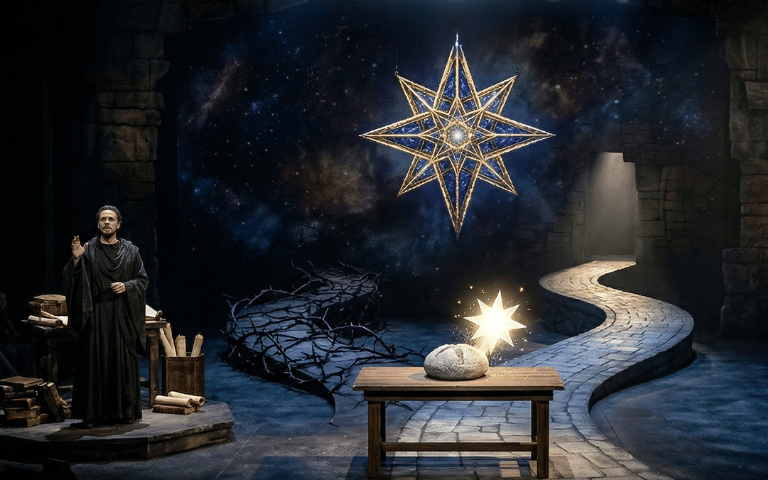
Currently in very early stages of development
More to come soon!
© 2026 JayRr Music & BluePrint Entertainment. All rights reserved.