
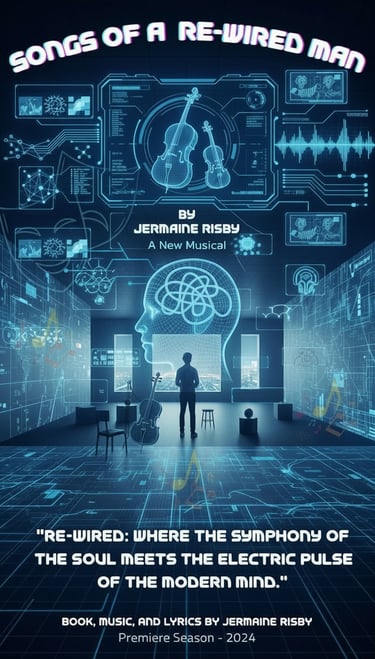
Songs of a Re-Wired Man
The song list for Songs of a Re-Wired Man follows Jamal's internal journey through a 18-question diagnostic self-assessment. The musical numbers are categorized by the specific cognitive or social traits they explore:
Act I: The Assessment
"The Pinball Fugue": Explores cognitive processing, executive dysfunction, and the "network" of a distracted mind.
"The Masking Variations": Details the "full-time job" of social adaptation and performing a "functional" persona to fit in.
"NPC": A song about social connection (or the lack thereof), where Jamal feels like a "Non-Playable Character" or a background process in the lives of others.
"Mirror/Static": Addresses identity and society, focusing on the "static" of external projections regarding a Black, queer, and neurodivergent body.
"The Diction Song": Focuses on finding an authentic voice versus the "white correction" and rigid training of professional speech.
"Lonely Maze": Captures the feeling of sensory and social overload, where the social mask finally slips.
Act II: The Integration
"The Blueprint": A celebratory realization that Jamal’s traits are a "custom-built" architecture rather than a list of failures.
"The Leading Men": Highlights pattern recognition by weaving the legacies of Norm Lewis, Brian Stokes Mitchell, and Sammy Davis Jr. into Jamal's mental map.
"The Algorithm Knows": A hyperpop confrontation with the digital "malware" and targeted ads that feed on neurodivergent anxiety.
"My Symphony": An eclectic number that integrates Jamal's special interests, including Bach, church choir, Sondheim, and K-pop (SHINee).
"Well, What Next?": A pragmatic song about action, planning, and taking "baby steps" toward neuro-integration.
"Fool": A vulnerable exploration of intimacy and the fear that inauthenticity might prevent close relationships.
"Songs of a Re-Wired Man": The finale that reprises the show's themes, confirming that Jamal is the "author of his own manual".
Song List
Writing Songs of a Re-Wired Man was not just a creative exercise; it was a necessary act of architectural salvage. For a long time, I lived in the abstract space of my own mind, viewing my internal rhythms as a "broken, faulty system" that needed constant repair or, worse, "white correction" to be deemed functional by the world around me. This show is a deeply personal reflection on that struggle—the exhaustion of "masking" to appear safe and the heavy toll of feeling like a "Non-Playable Character" in a world built on a different operating system.
This journey is mine. Like Jamal, I have navigated the intersection of being Black, queer, and neurodivergent, often mistaking the "static" of society’s projections for my own internal signal. I spent years trading the "pure signal" of my own passions for the noisy judgment of others, drilling my diction and dampening my spirit just to fit a traditional mold
I created this show to turn off that external noise and finally listen to the music on the inside. It is a celebration of the "custom-built" architecture of the mind. From the meticulous "Pinball Fugue" of cognitive processing to the "My Symphony" of eclectic interests—Bach, Sondheim, and even the digital energy of K-pop—this show is a map of how I learned to stop trying to fix the machine and finally start writing my own program
Ultimately, Songs of a Re-Wired Man is about the grace of self-discovery. It is my way of standing center stage, unmasked and unfiltered, to say that I am not a glitch—I am a masterpiece in progress, perfectly aligned with a blueprint that was always meant for me.
Note from the Writer
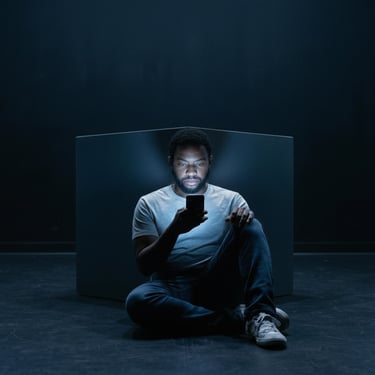
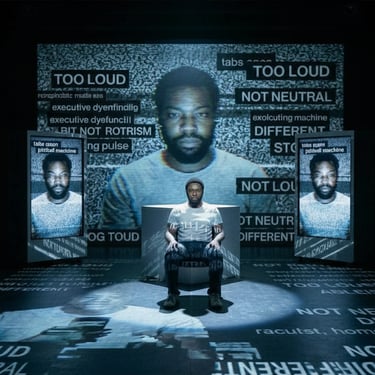
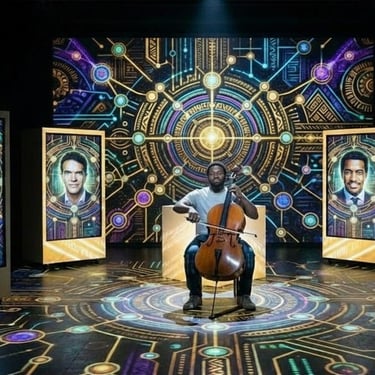
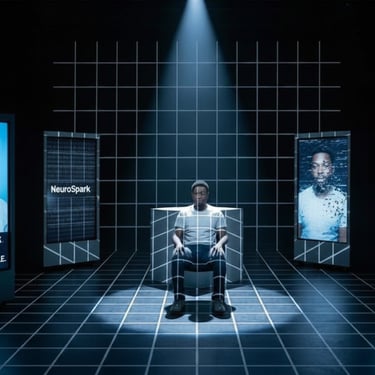
Songs of a Re-Wired Man is a conceptual one-man musical that takes place within the abstract, digital landscape of the protagonist's mind. Written by Jay Rr, the show follows Jamal, a Black neurodivergent man, as he undergoes a digital self-assessment for ADHD and Autism (AuDHD).
The narrative is framed as a journey from feeling like a "broken, faulty system" to embracing a "custom-built" internal architecture. The production utilizes extensive projections to create a dynamic neural network that evolves from a cold, corporate aesthetic into a vibrant, Afrofuturist blueprint. Musically, the show is an eclectic "symphony" that synthesizes Bach-inspired cello, Sondheim-style theater, 90s pop, and K-pop
Act I: The Assessment
The first act centers on Jamal's initial confrontation with his neurodivergent traits through an 18-question screening tool called "NeuroSpark".
Themes: Executive dysfunction, social "masking," and the feeling of being an "NPC" (Non-Playable Character) in other people's lives.
Key Moments: Jamal describes his brain as a "pinball machine" where every voice sings at once. He explores the "full-time job" of mimicry required to appear functional and the pain of "white correction" regarding his natural speaking voice and diction.
Ending: Act I concludes with Jamal feeling overwhelmed by social situations, describing his existence as a "phantom life"
Act II: The Integration
The second act shifts from diagnosis to self-authorship as Jamal interprets his traits as a "blueprint" rather than a list of symptoms.
Themes: Afrofuturism, pattern recognition, and reclaiming agency from digital algorithms.
Key Moments: Jamal identifies his personal "Leading Men"—Norm Lewis, Brian Stokes Mitchell, and Sammy Davis Jr.—as foundational nodes in his mental architecture. He recognizes the "malware" of targeted digital ads that feed on his anxieties and chooses to log off their network to stay on his own.
Finale: Jamal realizes he is the "coder of his soul". He reconfigures his mental space into an open, inviting architecture and performs a final melody on his cello that integrates the various musical styles of his life.
© 2026 JayRr Music & BluePrint Entertainment. All rights reserved.