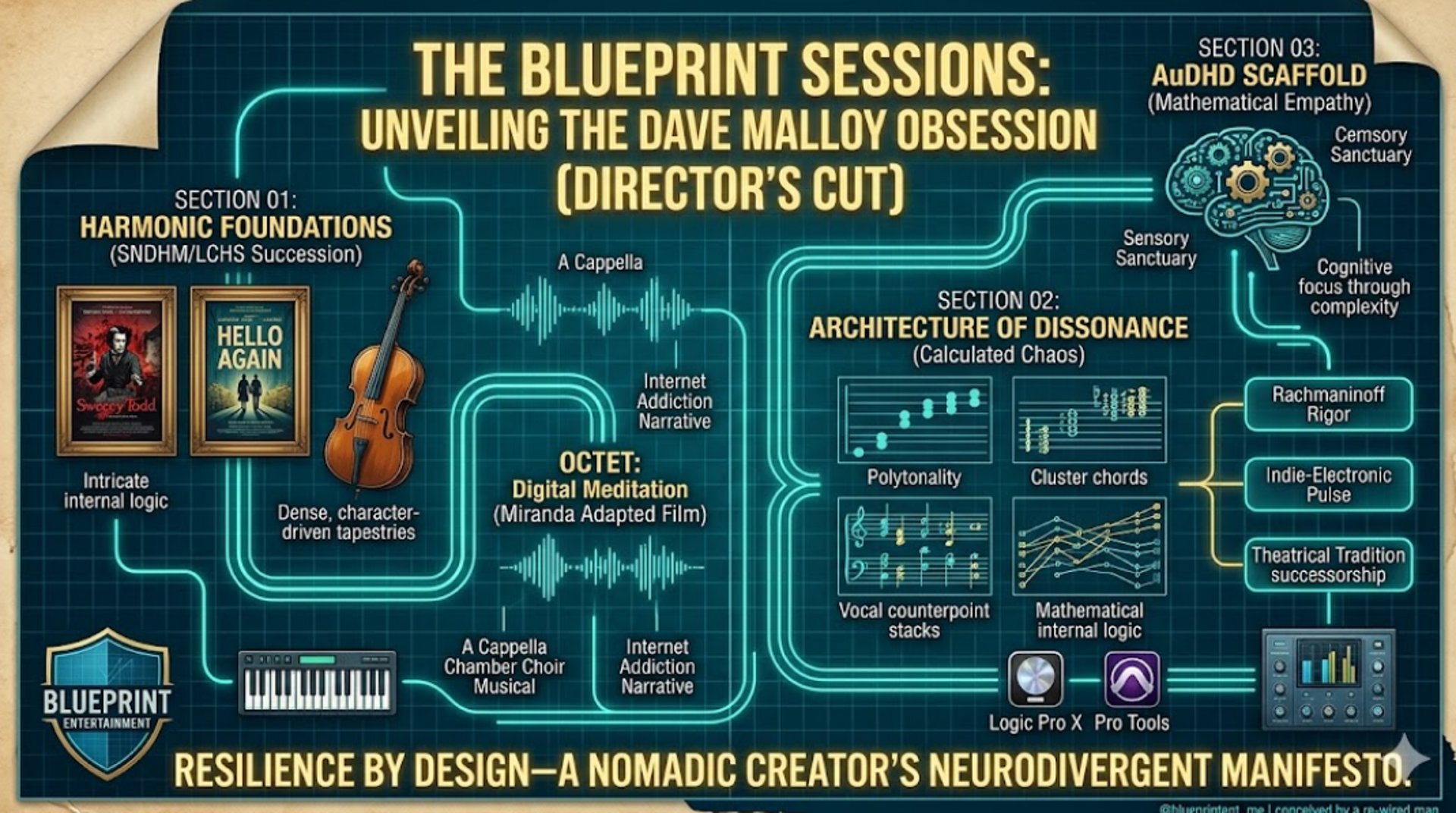
The New Frontier of the Interior: Decoding the Brilliance of Dave Malloy
A deep dive into the "Mathematical Empathy" of Dave Malloy’s music, exploring how his complex dissonance and intricate vocal architecture act as a vital sensory scaffold for the neurodivergent creator.
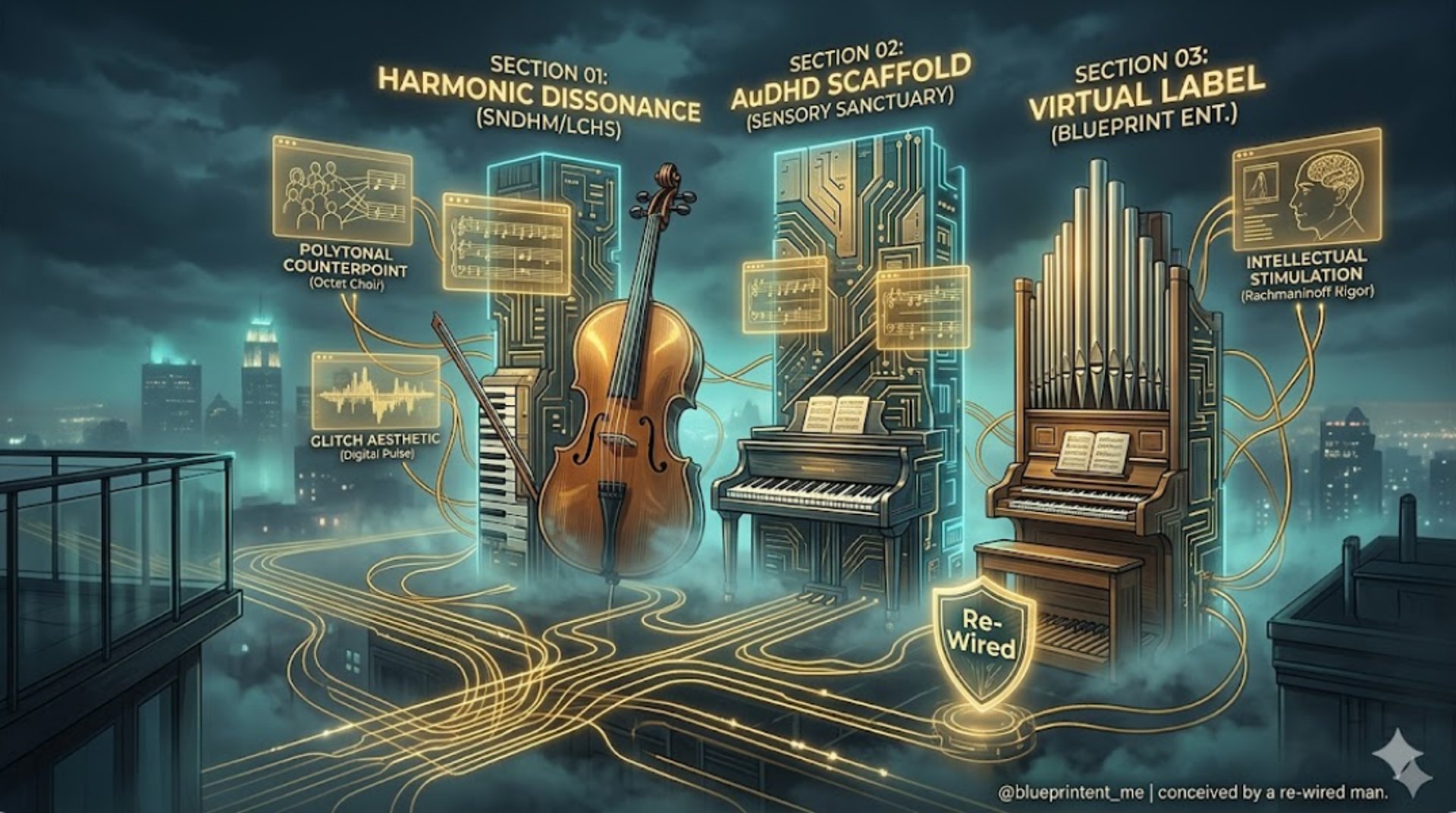
If you’ve been following the Architect’s Log, you know I don’t just "listen" to music. I dissect it. I look for the structural integrity, the intentional dissonance, and the emotional resonance that only a few composers can actually achieve. For years, my North Star has been the complex, jagged geometry of Stephen Sondheim and the dense, character-driven tapestries of Michael John LaChiusa.
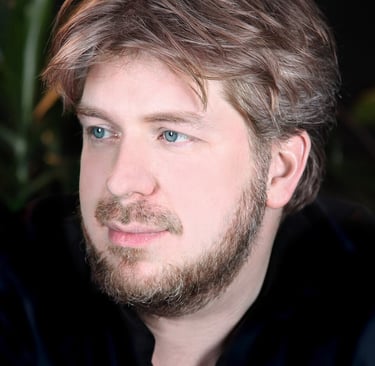
But I’ve recently found a new obsession that feels like the contemporary successor to that lineage: Dave Malloy.
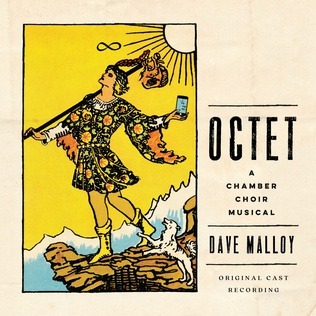
Discovering Malloy's work—from the electro-pop delirium of Natasha, Pierre & The Great Comet of 1812 to the haunting, a cappella digital-age meditation of Octet—has been like finding a missing piece of my own creative DNA.
The Contemporary LaChiusa: A Master of Subtext
Malloy is, in many ways, the modern-day LaChiusa. Like LaChiusa, Malloy refuses to write "easy" music. He doesn’t give you the predictable A-B-A-B pop structure. Instead, he treats a score like a living, breathing psychological profile.
When I first experienced Great Comet, I was struck by how he took a sliver of War and Peace and turned it into an immersive, multi-genre experience. But it was Octet that truly stopped me in my tracks. Hearing that it’s being adapted into a film by Lin-Manuel Miranda is the ultimate validation of its importance. Octet is a "Chamber Choir Musical" about internet addiction, and for someone who lives in the digital space building virtual empires, it hit a nerve I didn't know I had.
The Architecture of Dissonance
Coming from a background in music education and a deep love for Sondheim, I am obsessed with how Malloy plays with chord progressions and dissonance.
He doesn't use dissonance as a gimmick; he uses it as a mirror. In Malloy’s world, a "cracked" chord or an unresolved suspension represents the internal friction of the characters. His music is filled with:
Polytonality & Cluster Chords: He isn't afraid to let notes rub against each other, creating a physical sensation of tension that mirrors the "internal static" I often talk about.
The "Calculated" Chaos: Much like Sondheim's Sweeney Todd, Malloy’s music feels like it’s constantly on the verge of spiraling out of control, yet it is held together by a rigid, mathematical internal logic.
Vocal Counterpoint: His ability to layer voices—especially in Octet—reminds me of the intricate vocal engineering I’m doing for THE IDEAL. It’s about five, six, eight voices all moving independently but creating one massive, complex organism.
The AuDHD Brain: A Symphony of Stimulation
I want to get personal for a second. As someone navigating the world through the lens of being Autistic and AuDHD, most mainstream music feels "flat." It’s predictable, and for a brain that is constantly seeking high-level input and structural complexity, it can be understimulating.
Dave Malloy’s music is a feast for the neurodivergent mind. For an AuDHD brain, his music provides the "dopamine hit" of complexity. When I listen to his scores, my brain is actively "solving" the music. I am tracking the shifting time signatures, the leitmotifs that hide in the subtext, and the way he blends Russian folk, techno, and classical art songs.
It’s "Mathematical Empathy." It’s a sensory experience that feels like a weighted blanket for my mind—the complexity provides a focus that simple music cannot. It takes the "noise" of my internal world and organizes it into a beautiful, jagged blueprint.



A Multitude of Influences
What makes Malloy so vital right now is the sheer breadth of his musical vocabulary. When you listen to his work, you hear:
The Classical Rigor: The influence of Rachmaninoff and the deep, choral traditions of the Orthodox Church.
The Indie-Electronic Pulse: The "glitch" aesthetic that I incorporate into the BluePrint sound.
The Theatrical Tradition: The ghost of Sondheim’s "The Miller's Son" and the sprawling, episodic nature of LaChiusa's Hello Again.
The Architect’s Conclusion
Dave Malloy is proving that musical theater can be avant-garde, technically brilliant, and deeply human all at once. He is taking the "Cultural Technology" of the past and re-wiring it for the digital age.
For the Re-Wired Man, Malloy’s music isn't just entertainment—it’s a digital scaffold. It’s a reminder that beauty doesn't have to be symmetrical to be perfect. Sometimes, it’s the dissonance that makes the foundation strong.
// STATUS: OBSESSION_VALIDATED // INFLUENCE_LEVEL: CRITICAL // ACCESS_PLAYLIST: Octet (Original Cast Recording)
#DaveMalloy #MusicalTheater #SondheimVibes #LaChiusa #AuDHD #MusicTheory #TheArchitect #BluePrintEntertainment #Octet #GreatComet
© 2026 JayRr Music & BluePrint Entertainment. All rights reserved.