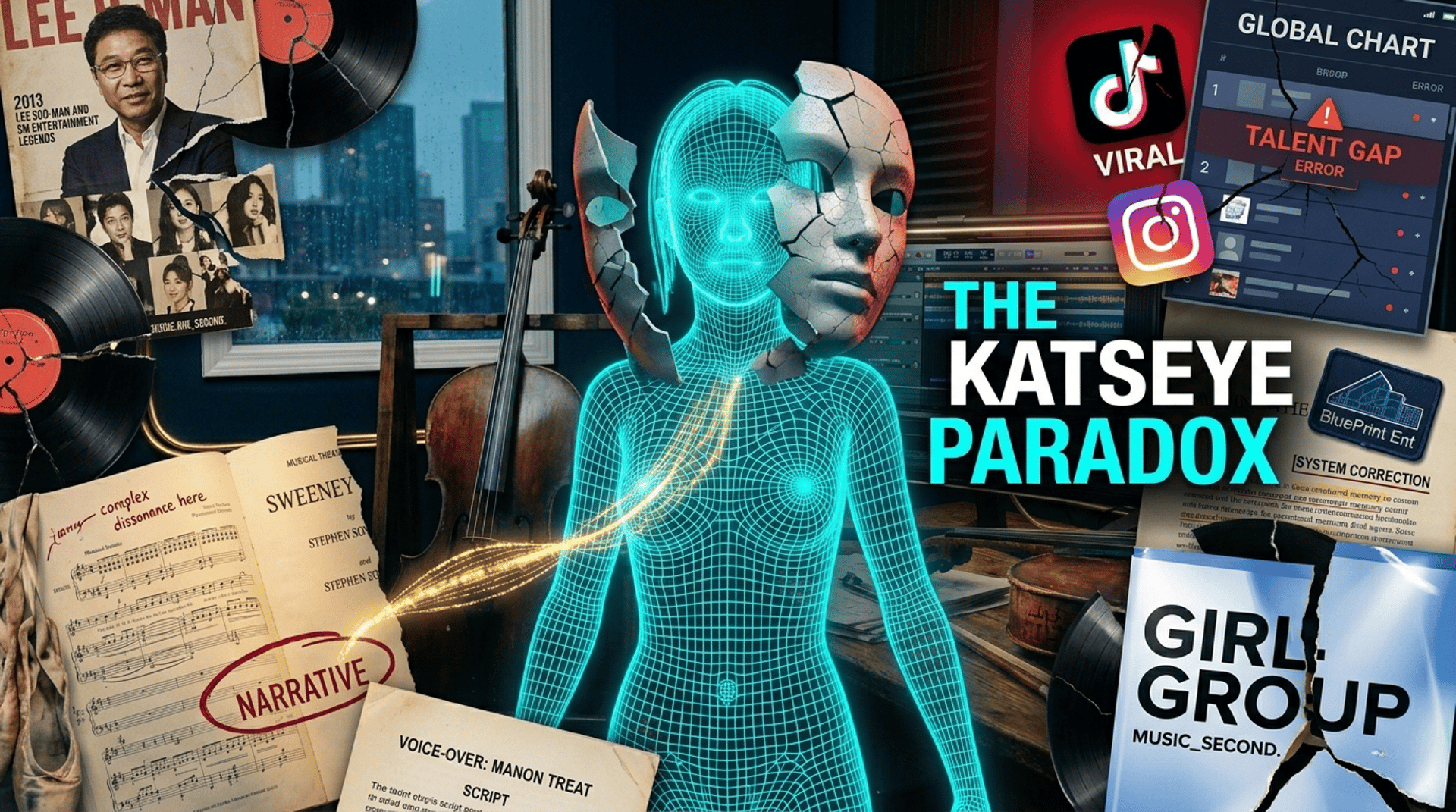
The KATSEYE Paradox
JayRr delivers a deep-dive critique of KATSEYE and the 'Viral Trap' of modern girl groups. Learn how the flaws in the K-pop-to-West methodology inspired the 'Music-First' architecture of BluePrint Entertainment.

The Dream of 2013: The Lee Soo-man Era
In 2013, while I was navigating the worlds of theater and music education, I was also a devout student of the "Gods" of K-pop. At that time, Lee Soo-man wasn’t just a CEO; he was the architect of Cultural Technology. I sat in the margins of my classical studies and my acting rehearsals, dreaming of a label that could take that rigorous, methodical K-pop training and "re-wire" it for the Western soul. I saw a future where a global group could have the discipline of Seoul and the raw, narrative grit of New York.
When KATSEYE was announced—a truly global collaboration between Hybe and Geffen—it felt like the culmination of that 13-year-old dream. This was supposed to be the "Apex" girl group.


The Branding Fracture: The Manon Look
In the world of virtual music architecture, your brand is only as strong as its internal logic. The public handling and perceived treatment of Manon during the group's formation and rollout was a massive failure in brand integrity.
Whether the friction was real or edited, it created a narrative of exclusion. In my "Unmasked and Unbroken" philosophy, the collective is sacred. To see a group’s brand fracture before it even finds its footing is a "bad look" that alienates the very global audience they were trying to capture. It lacks the "Unbroken" resilience that a true global icon needs.
The Virtual Correction: Doing It Right
Watching this play out has only solidified my mission for BluePrint Entertainment. By launching a Virtual Label, I am removing the toxic variables and corporate greed that lead to "viral-first" music.
Musical Sovereignty: Because I have a deep music background, I am the one controlling the vocal arrangements, the complex dissonances, and the narrative arcs. My girl groups, like THE IDEAL, are built on the "Greats." They are performing music that demands to be heard, not just "shuffled."
The "Manon" Solution: In a virtual space, I can highlight every member’s individuality without the behind-the-scenes politics. Every artist is protected by the blueprint.
Cultural Technology 2.0: I am finally executing that 2013 dream. I’m taking the training methods I admired in Lee Soo-man and grounding them in the human vulnerability of my own journey.
I don’t want to go viral for a week. I want to architect a sound that lasts twenty years. KATSEYE proved that the world is ready for a global group; BluePrint is here to prove that the world is ready for a group with a soul.
The Viral Trap: Talent vs. Trends
My disappointment began not with the girls, but with the foundation. The K-pop methodology is designed to create Idols—larger-than-life figures who command respect through sheer skill. However, the Western execution of KATSEYE feels like it was architected by a marketing department rather than a musical director.
We are living in an era where labels are obsessed with "Virality" over "Vocality." The focus has shifted from bringing world-class, undeniable talent to the forefront to chasing 15-second TikTok "moments." As someone who has spent twenty years studying the harmonic intricacies of Sondheim and the vocal demands of the stage, I find the music hollow. It’s designed to be a background track for a dance challenge, not a legacy-defining anthem. When you build a group to go viral, you build it to be disposable.




© 2026 JayRr Music & BluePrint Entertainment. All rights reserved.