My decision to dive into musical theater composition is a natural evolution of a life lived on both sides of the footlights. Before I was a composer, I was a performer, and my time on stage in roles like Roger in A New Brain, Coalhouse Walker Jr. in Ragtime, and Hud in Hair gave me a visceral understanding of how a score needs to breathe. That history as a performer is what fuels my writing today; I don’t just write notes on a page, I write for the performer standing in the spotlight, looking for that emotional truth. While my other production work allows me to explore the polished, high-energy world of contemporary pop, musical theater is where I go to explore the complex "gray areas" of the human experience.
My musical ear was forged in the fires of the avant-garde and the intellectually challenging. Coming from a classical background, I was never the type of listener—or performer—who needed a simple, hummable melody to become obsessed. I gravitated toward the obscure and the intricate. Stephen Sondheim was, of course, the blueprint, but discovering Jason Robert Brown’s scores for Songs for a New World and Parade truly unlocked my understanding of contemporary theater writing. Alongside the sophisticated textures of Maltby & Shire, the whimsical yet deep work of Jones & Schmidt, and the bold, dissonant brilliance of Michael John LaChiusa, my sensibilities were shaped by writers who aren't afraid of complexity. They taught me that a musical can be as rigorous and demanding as any classical concerto.
I’m often asked about my process, especially since I am not a traditional pianist. However, in this era of "Cultural Technology," I view my workstation as my instrument. With the help of MIDI and advanced software, I am able to translate the sophisticated melodies and lyrics in my head into fully realized, unique compositions. This technology allows me to take my songwriting to the next level, bypassing the need for ten fingers on a keyboard to instead focus on the architecture of the song. It gives me the freedom to create scores that are a far cry from the pop charts—compositions that are experimental, fun, and deeply rooted in the storytelling tradition that first drew me to the stage all those years ago.
[ DIRECTOR'S CONSOLE // STAGE CONTROLS ]
As a composer, performer, and writer, I view my workstation as my stage. Interact with the digital dimming board below to alter the visual lighting mood of the stage, or run a live Web Audio sound sweep to tune the acoustic resonance.
Stage Lighting Presets
Acoustic Room Tuning
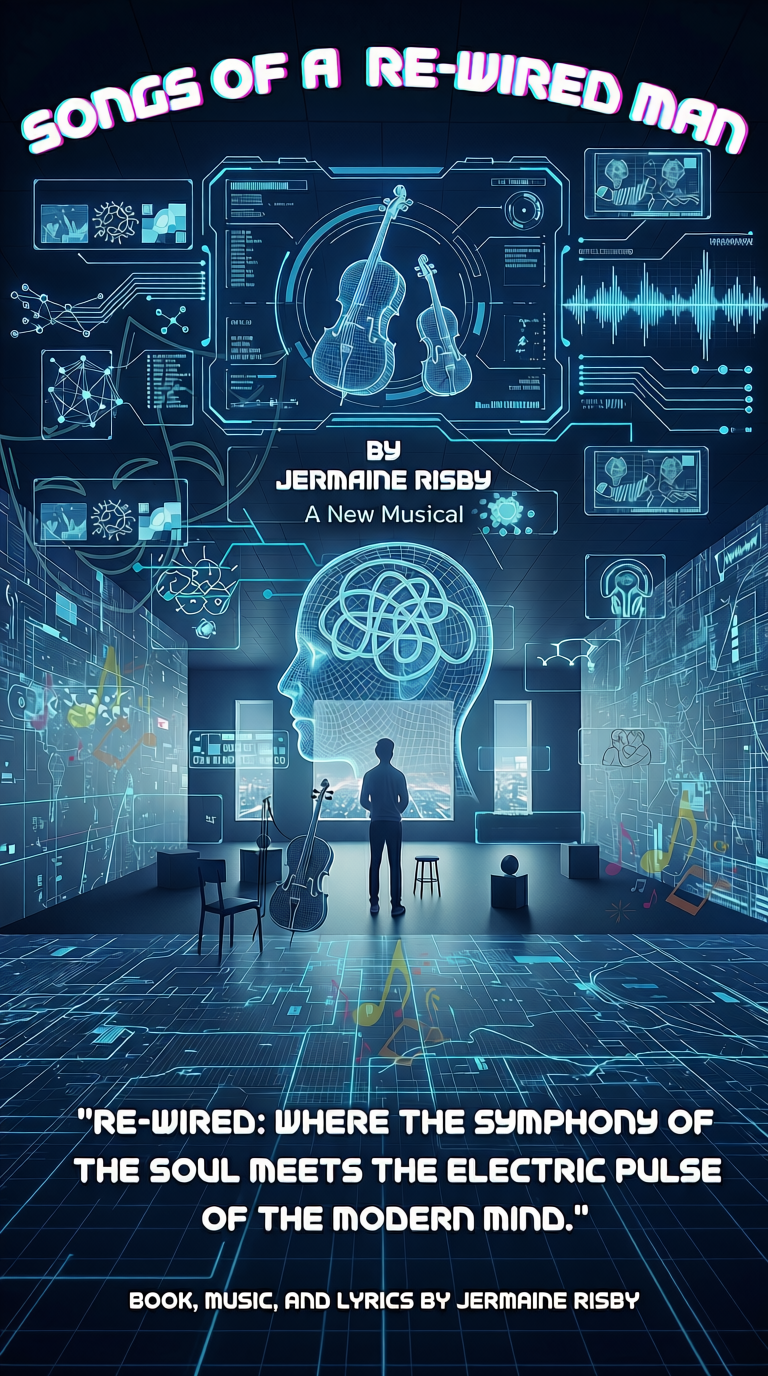
SONGS OF A RE-WIRED MAN
Book, Music & Lyrics by Jermaine Risby (Jay Rr)
"Inside Out meets Black Mirror with live electro-acoustic cello looping."
Songs of a Re-Wired Man is a groundbreaking electro-acoustic musical in two acts set within the abstract, high-tech digital landscape of the protagonist's mind—framed as the "NeuroSpark AuDHD Diagnostic Self-Assessment." The show follows Jamal, a Black queer AuDHD artist and cellist (late 20s–early 30s), as he navigates an 18-question diagnostic screening while facing a real-world emergency: an overdue Housing Assistance Appeal Notice with a live countdown timer (00:52:14...) ticking down to midnight on HUD Monitor 1.
Over the course of 14 songs across 2 acts, Jamal transitions from viewing his neurodivergence as broken code or a collection of faulty symptoms to embracing it as a custom-built blueprint for self-authorship. The production utilizes extensive projections to create a dynamic neural network that evolves from cold, corporate glass-morphism into a vibrant Afrofuturist matrix. Musically, the show is a virtuoso electro-acoustic symphony synthesizing Bach-inspired cello looping, Sondheim-style patter fugues, Jason Robert Brown conversational melodies, Gospel soul, and K-pop synth hooks (SHINee).
Character & Vocal Architecture (The Quartet of Consciousness)
JAMAL (Protagonist)
High Baritone / Tenor (G2–A4, Belt to C5). Black, Queer, AuDHD Artist & Cellist. Plays live acoustic cello on stage routed through a Boss RC-505 looper pedal board.
THE ANALYST (Sub-Processor 01)
Bass-Baritone (E2–F4). Risk Assessor & Metric Engine. Fast Sondheim staccato patter. Clinical corporate blue HUD diagnostics.
THE PERFORMER (Sub-Processor 02)
Countertenor / High Tenor (A3–E5). Social Firewall & Masking Engine. Polished chamber pop, live Auto-Tune, glass-morphism, "Smile Capacity %".
THE ARTIST (Sub-Processor 03)
Resonant Soul Tenor (C3–Bb4). Creative Engine & Sensory Grounding. Gospel, soul, jazz, 65.4Hz sub-bass, amber/gold cosmic waveforms.
Inspiration & DNA
Personal Context: Grounded in the creator's unmasked journey as a Black, queer, and neurodivergent man navigating society's expectations versus internal signals. It celebrates AuDHD as a "hyper-focused" superpower rather than a collection of failures.
Theatrical & Musical Influences: Merges live cello looping (65.4Hz C-string drone, percussive bow chops, octave fuzz) with the staccato patter fugues of Stephen Sondheim, the intricate conversational melodies of Jason Robert Brown, the dissonant complexity of Michael John LaChiusa, Bach cello suites, Gospel choir, and K-Pop synth hooks (SHINee).
The Narrative Structure
Act I: The Assessment
Cold corporate blue LED lighting (#004488) and glass-morphism overlays. Jamal steps over a red Housing Appeal Notice envelope, plucks his low C-string (65.4Hz), and initiates the "NeuroSpark" screening. Driven by the ticking clock on HUD Monitor 1 (00:52:14...), his executive sub-processors manifest as the Quartet of Consciousness. Themes explore the 7/8 polyrhythmic "Pinball Fugue" of cognitive processing and Swingline red stapler hyper-focus, the heavy toll of social "Masking Variations" and auto-tuned camouflage, feeling like a non-playable character ("NPC") in corporate spaces, white noise static on a Black queer frame ("Mirror/Static"), resisting classical vocal bleaching ("The Diction Song"), and sensory overload ("Lonely Maze"), culminating in Jamal stomping the looper Master Kill-Switch into complete blackout.
Act II: The Integration
Shifts to a warm Afrofuturist neural matrix (Gold #D4AF37, Indigo #1A0033). Jamal reboots his kernel, realizing his traits form a "custom-built blueprint" rather than a list of defects. He draws strength from his musical "Leading Men" (Norm Lewis, Brian Stokes Mitchell, Sammy Davis Jr.), logs off predatory targeting algorithms ("The Algorithm Knows"), builds his master multi-genre loop ("My Symphony" featuring The Pinball Fugue Reprise), completes his housing appeal form with steady hands ("Well, What Next?"), sheds his social firewall ("Fool" featuring The Masking Variations Reprise in warm D Major), and arrives at his grand finale ("Songs of a Re-Wired Man"), declaring himself the author of his own manual with a soaring C-Major cello chord.
ACT I: THE ASSESSMENT
- "Scene 1: System Boot / The Rabbit Hole" Diagnostic initialization; Jamal steps over the red envelope; live C-string loop established.
- "Scene 2: The Pinball Fugue" Question 1 (Organization); 7/8 polyrhythmic 4-part fugue; Swingline red stapler hyper-focus vs. appeal notice.
- "Scene 3: The Masking Variations" Question 2 (Mimicry); metronomic arpeggio; F#m7b5 tension, social camouflage scripts, and auto-tune override.
- "Scene 4: NPC (Non-Playable Character)" Question 3 (Social detachment); acoustic cello ballad; feeling incompatible in corporate spaces.
- "Scene 5: Mirror / Static" Question 4 (Rejection sensitivity); fuzz pedal distortion; internalizing systemic static on a Black queer body.
- "Scene 6: The Diction Song" Question 5 (Special interests); Bach prelude to Broadway satire; resisting classical vocal bleaching.
- "Scene 7: Lonely Maze" Question 6 (Social overload); swarming looper feedback crescendo; Master Mute Kill-Switch stomp.
ACT II: THE INTEGRATION
- "Scene 1: The Blueprint" Afrofuturist neural matrix reboot in gold and indigo; viewing traits as a custom-built blueprint.
- "Scene 2: The Leading Men" High pattern recognition; tribute to Norm Lewis, Brian Stokes Mitchell, Sammy Davis Jr.
- "Scene 3: The Algorithm Knows" Targeted 3 AM ads vs. 5-minute appeal countdown; logging off external clouds.
- "Scene 4: My Symphony" Multi-genre loop build (Bach + Pop + Sondheim + K-Pop) featuring The Pinball Fugue Reprise.
- "Scene 5: Well, What Next?" Completing the housing appeal form with steady hands; intake call booking.
- "Scene 6: Fool" Unmasking solo ballad preceded by The Masking Variations Reprise in warm D Major.
- "Scene 7: Songs of a Re-Wired Man (Finale)" Grand finale anthem featuring System Boot Reprise; authoring his own manual with soaring C-Major cello resonance.
Note from the Writer
Writing Songs of a Re-Wired Man was not just a creative exercise; it was a necessary act of architectural salvage. For a long time, I lived in the abstract space of my own mind, viewing my internal rhythms as a "broken, faulty system" that needed constant repair or, worse, "white correction" to be deemed functional by the world around me. This show is a deeply personal reflection on that struggle—the exhaustion of "masking" to appear safe and the heavy toll of feeling like a "Non-Playable Character" in a world built on a different operating system.
This journey is mine. Like Jamal, I have navigated the intersection of being Black, queer, and neurodivergent, often mistaking the "static" of society’s projections for my own internal signal. I spent years trading the "pure signal" of my own passions for the noisy judgment of others, drilling my diction and dampening my spirit just to fit a traditional mold.
I created this show to turn off that external noise and finally listen to the music on the inside. It is a celebration of the "custom-built" architecture of the mind. From the meticulous "Pinball Fugue" of cognitive processing to the "My Symphony" of eclectic interests—Bach, Sondheim, and even the digital energy of K-pop—this show is a map of how I learned to stop trying to fix the machine and finally start writing my own program.
Ultimately, Songs of a Re-Wired Man is about the grace of self-discovery. It is my way of standing center stage, unmasked and unfiltered, to say that I am not a glitch—I am a masterpiece in progress, perfectly aligned with a blueprint that was always meant for me.
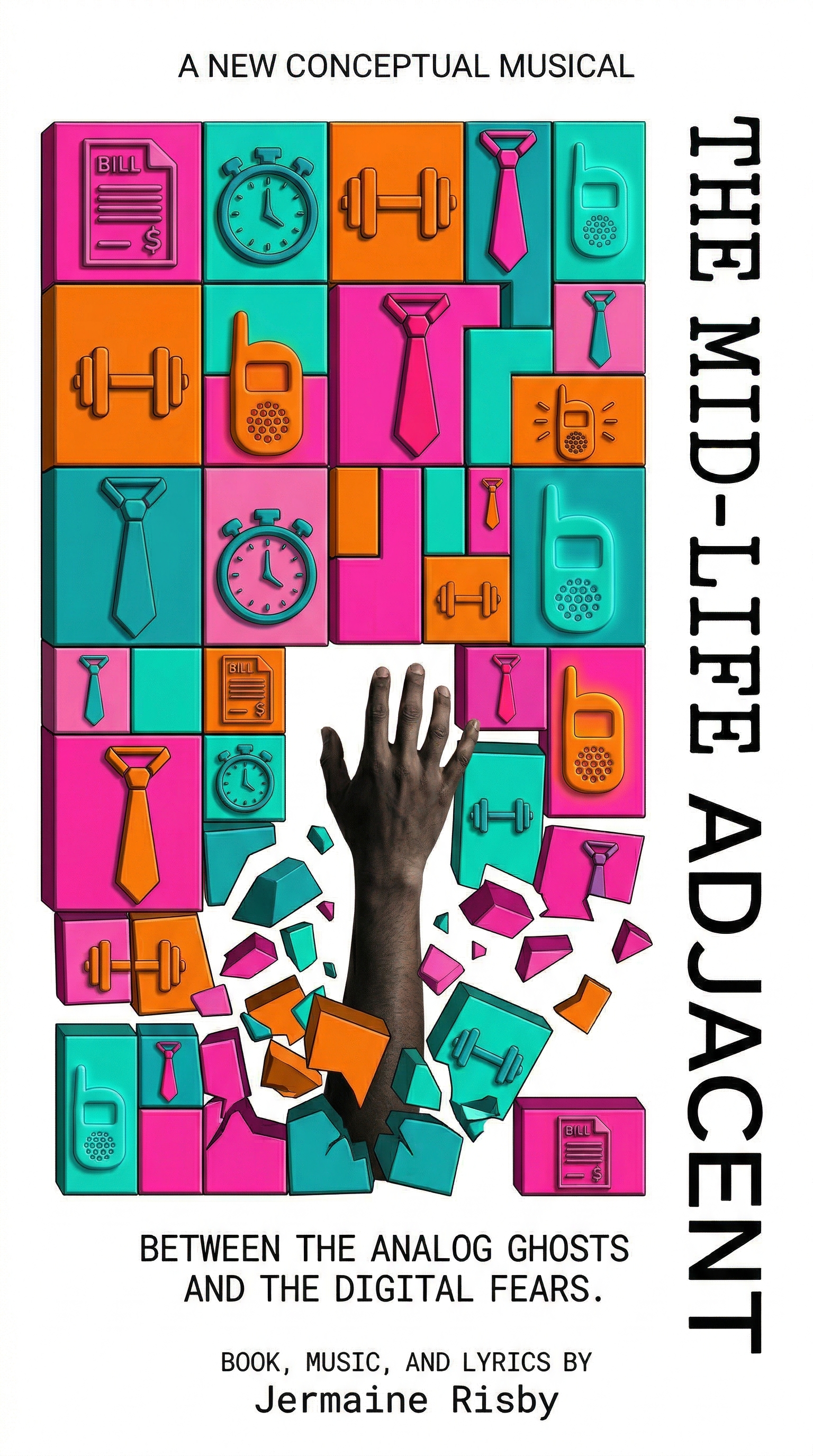
MID-LIFE ADJACENT
Conceived by Jermaine Risby (Jay Rr)
Mid-Life Adjacent is a contemporary conceptual musical in two acts that explores the complexities of identity, aging, and the digital experience for the millennial generation. Written by Jermaine Risby (also known as Jay Rr), the production utilizes a blend of contemporary musical styles—including driving piano, rhythmic jazz-patter, and aggressive synth-pop—to depict the transition from a "curated" digital existence to an "unfiltered" reality.
The musical serves as a commentary on the "bridge" generation caught between analog memories (like rotary phones and Blockbuster stores) and the overwhelming pressure of digital optimization, side-hustles, and social media validation.
Inspiration & DNA
The Millennial Bridge: Inspired directly by the "messy middle" transition of a generation caught between the analog textures of their youth and the clinical blue light of 21st-century optimization. It captures the modern fatigue of sleep apps, calorie-tracking "macros," and algorithmic isolation.
Lived Realities: Informed by the composer's experience at 42—grappling with the exact "physics" of aging, responsibility, Hospitality career demands, and the "re-wired" journey of launching a digital music studio.
The Narrative Structure
Act I: The Curated Exterior
Focuses on the performative nature of adulthood. It introduces "The Grid"—a world of handheld devices, sleep hygiene apps, and the frantic "commuter walk." Themes center on logistics over spontaneity, the "Tetris of obligations," and the cult-like obsession with physical fitness and "macros." Key moments explore the difficulty of making friends as adults due to "logistical puzzles" and celebrate the exhausting "40s is the New 20s" mentality.
Act II: The Unfiltered
Strips away the clinical blue light and performative glamour in favor of cold, grey-blue tones and "natural" light. Themes address the heavy systemic weight of the rising cost of living ("Tick, Tick, Tick"), biological clocks, and the grueling effort required to maintain long-term relationships. Key scenes negotiate racial identity in "The Weight of the Hue," deconstruct "The Nostalgic Bait," and accept that "The resolution is just a setting," ending with characters reclaiming a "new sanity."
ACT I: THE CURATED EXTERIOR
- Scene 1: THE GRID
Song 1: Mid-Life Adjacent (Ensemble) - Scene 2: THE CALENDAR
Song 2: The Scheduled Silence (Man 1) - Scene 3: THE MORNING GRIND
Song 3: The Morning Grind (Man 3 & Woman 3) - Scene 4: THE GREAT DIGITAL SHUFFLE
Song 4: The Great Digital Shuffle (Man 1, Man 2, Woman 1) - Scene 5: BETWEEN WORLDS
Song 5: Between Worlds (Man 2, Woman 2, Woman 3) - Scene 6: THE VIEW FROM THE GATE
Song 6: The View from the Gate (Woman 1 & Woman 2) - Scene 7: THE CULT OF THE CORE
Song 7: The Cult of the Core (Ensemble) - Scene 8: THE OFFICE
Song 8: The "Other Duties" Blues (Woman 1, Man 1, Man 3) - Scene 9: THE DEN OF DOMINANCE
Song 9: The Den of Dominance (Man 1, Man 3, Man 2) - Scene 10: THE VIEW FROM THE LANDING
Song 10: The View from the Landing (Woman 2 & Ensemble) - Scene 11: THE ALGORITHM OF AFFINITY
Song 11: The Algorithm of Affinity (Man 1, Man 3, Woman 1, Man 2) - Scene 12: THE MIDDLE PATH
Song 12: The Middle Path (The $100 Threshold) (Woman 3 & Woman 2) - Scene 13: 40s IS THE NEW 20s
Song 13: 40s is the New 20s (Ensemble)
ACT II: THE UNFILTERED
- Scene 14: TICK, TICK, TICK
Song 14: Tick, Tick, Tick (Ensemble) - Scene 15: THE BIOLOGICAL CLOCK-WORK
Song 15: The Biological Clock-Work (Woman 2) - Scene 16: THE SOFA
Song 16: The Heavy Lifting (Man 3 & Woman 2) - Scene 17: THE NURSERY OF THE MIND
Song 17: Lullaby for a Memory (Woman 3) - Scene 18: THE BENCH
Song 18: Ninety-Nine Problems (Ensemble) - Scene 19: THE WARDROBE
Song 19: The Weight of the Hue (Man 2 & Woman 1) - Scene 20: THE FINAL BOSS
Song 20: The Final Boss (Man 1) - Scene 21: NOSTALGIA BAIT
Song 21: The Nostalgic Bait (Ensemble) - Scene 22: THE FOUNTAIN OF YOUTH
Song 22: The Fountain of Youth (Woman 1, Woman 2, Woman 3) - Scene 23: THE FILTERED LIFE
Song 23: The Filtered Life (Man 1, Man 2, Woman 1, Woman 2) - Scene 24: THE NURSERY RUN
Song 24: There’s Nothing Like It (Ensemble) - Scene 25: THE HUM OF SILENCE
Song 25: The Hum of Stillness (Ensemble) - Scene 26: CLICHE LETTERS TO ONE’S SELF
Song 26: Cliche' Letters to One's Self (Man 2 & Ensemble) - Scene 27: UNFILTERED FINALE
Song 27: Unfiltered Second Act (Ensemble)
Note from the Writer
I created Mid-Life Adjacent to explore the "messy middle"—that specific, often-unspoken intersection where the analog nostalgia of our youth meets the relentless digital extraction of our present. This contemporary conceptual musical serves as a response to the unique weight carried by a generation caught between two worlds: the one defined by rotary phones and Blockbuster carpets, and the one dominated by "sleep hygiene" apps, algorithmic isolation, and the "Cult of the Core".
By structuring the revue into two acts, I wanted to mirror the duality of modern existence—moving from the frantic, high-definition performance of Act I’s "Curated Exterior" to the raw, systemic pressures of Act II’s "Unfiltered" reality.
At 42, I find myself standing exactly on this "bridge in the middle," navigating the same "physics" of aging and responsibility that I’ve written into these scenes. My own experiences—from balancing a career in hospitality to the "re-wired" journey of music production—directly inform the exhaustion of code-switching, the quiet grief of the "Nursery of the Mind," and the financial "triage" that defines our daily survival.
Ultimately, this work is an invitation to drop the filters and reclaim a sense of muscular solidarity; it is an assertion that this stage of life is not a crisis, but a hard-won clarity found in the beauty of a "messy," unfiltered truth.
* This show is still in development *
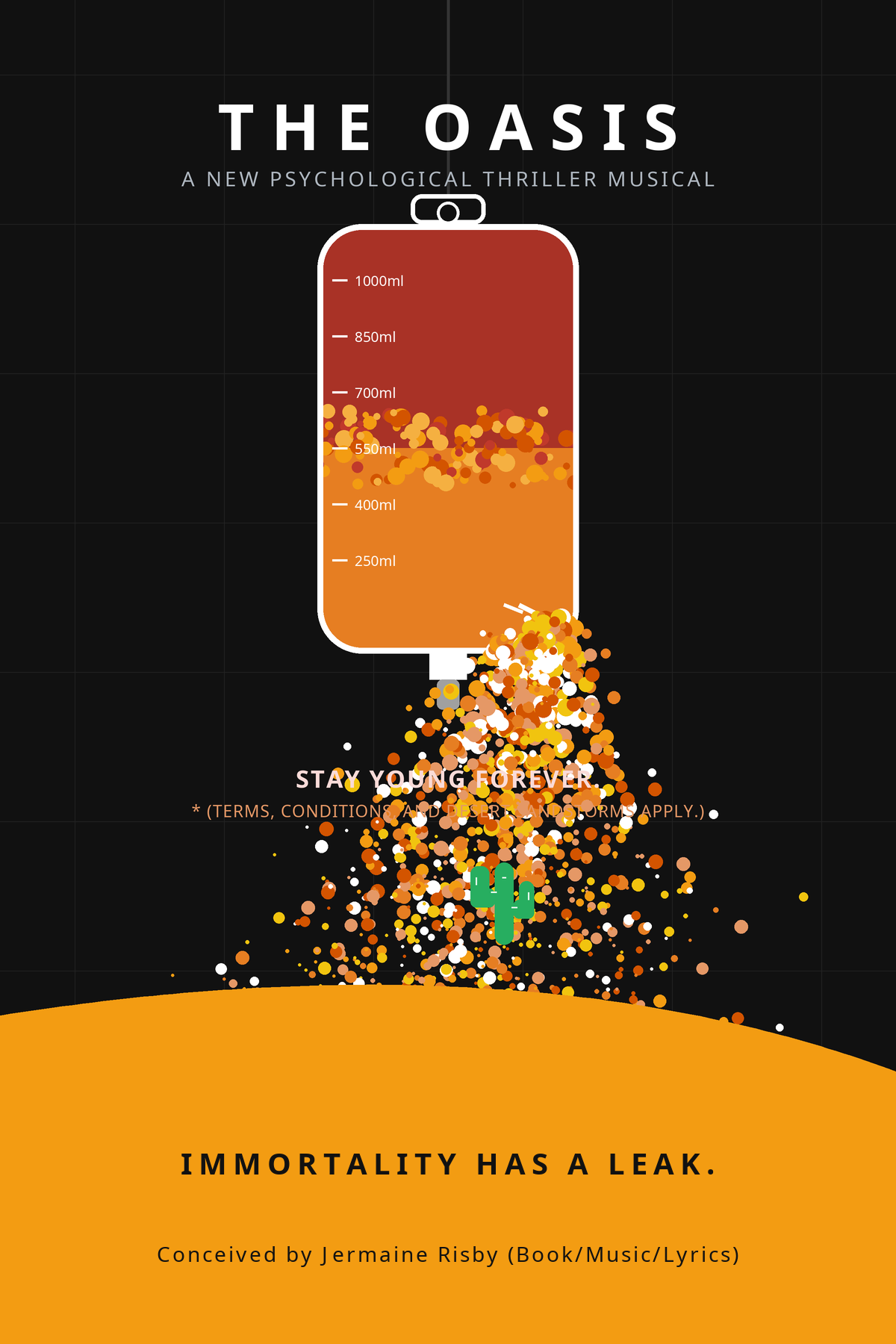
THE OASIS
Conceived by Jermaine Risby (Jay Rr)
The Oasis is a fragmented, thematic "Concept Musical" designed as a psychological interrogation of the human obsession with longevity and the grotesque commodification of "stopping time" . Set in a "Radical Bio-Hacking and Longevity Desert Commune"—a billion-dollar fortress for the ultra-wealthy seeking to reverse the clock—the show elevates the stakes from mere vanity to a desperate, scientific war against entropy .
The dramatic engine is ignited by a dual catalyst: an unseasonal desert sandstorm that severs the digital biometric tethers to the outside world, and the accidental distribution of an experimental, hallucinogenic "cleansing tea" . This "locked-room" setting strips away the characters' curated masks, forcing a collapse of the artificial self and leading to an intense, claustrophobic psychological thriller where the only escape is the acceptance of one’s own finite nature .
Inspiration & DNA
Anti-Stasis & Humanity: A direct commentary on modern transhumanist obsession with biological optimization . It is a rejection of artificial preservation, celebrating the messy, finite beauty inherent in aging .
Theatrical Influences: Combines the dramaturgical rigor of Stephen Sondheim with the complex, character-driven dissonances of Michael John LaChiusa . The show mandates an exclusively acoustic score—strictly restricted to Solo Acoustic Piano & Vocals—utilizing percussive tone clusters and prepared piano techniques to prevent generic electronic production .
Acoustic & Lyric Rigor: Features a recurring 5-note "Anxiety Motif" of mortality (fast staccato in Act I, inverted slow romantic chorale in Act II) , alongside a strict Mandatory Perfect Rhyme rule representing the defensive intellectual armor of its guests .
The Narrative Structure
Act I: The Curated Self
Takes place within a hyper-sterile, white clinical bio-dome—a space of artificial stasis and geometric perfection . The audience meets the characters: Roxy Royale, the glamorous, tyrannical Drag CEO ; Clara Winter, the hyper-rigid clinical psychologist obsessed with metrics ; and named guests Arthur (Optimization Obsessive), Elena (The Transfusionist), and Marcus (Cryo-Tank Zealot) . As the unseasonal sandstorm hits and the hallucinogenic tea is distributed , the clinical motifs break down into a feral, polyphonic Act I finale where the guests tear off their designer clothes .
Act II: The Authentic Self
Presents the aftermath: entropic, scorched ruins covered in desert sand, visually representing the shattered "designed" life . The clinical biometric tethers are gone, forcing a raw psychological confrontation between Clara's diagnostics and Leo Vance—the off-the-grid drifter who breached the compound . As Clara's mathematical precision stutters into silence , Roxy's bitonal power collapses into a naked, a cappella whisper . The characters accept human entropy, walking into the sun as messy, finite, aging human beings .
ACT I: THE CURATED SELF
- Scene 1: ARRIVAL
Song 1: THE RECITER'S WARNING / SAND (Leo & Ensemble) - Scene 2: THE INTAKE
Song 2: THE INTAKE (Greek Chorus) - Scene 3: THE BIO-DOME
Song 3: PERFECTLY ALIGNED (Roxy) - Scene 4: THE MEASUREMENT
Song 4: THE SCHEDULE (Clara) - Scene 5: THE BLACKOUT
Song 5: THE BREACH (Leo, Clara, Roxy) - Scene 6: THE TEA
Song 6: RASHOMON IN THE DARK (Full Company) - Scene 7: THE CRASH
Song 7: THE DROP (Full Company - Act I Finale)
ACT II: THE AUTHENTIC SELF
- Scene 8: THE DESERT INTRUSION
Song 8: SALT & DUST (Greek Chorus) - Scene 9: UNMASKED
Song 9: UNMONITORED (Roxy) - Scene 10: THE BREAKDOWN
Song 10: THE SCHEDULE (REPRISE) (Clara) - Scene 11: THE DRIFTER
Song 11: CONVERSATIONS WITH A DRIFTER (Clara & Leo) - Scene 12: VULNERABILITY
Song 12: I WISH I COULD FORGET (Clara) - Scene 13: THE PATHOGEN FEAR
Song 13: THE WITCH HUNT (Roxy & Guests) - Scene 14: LIBERATION
Song 14: BREAK THE GLASS (Leo) - Scene 15: ENTROPY
Song 15: SAND (REPRISE) (Leo) - Scene 16: FINALE
Song 16: PERFECTLY ALIGNED (REPRISE) / FINALE (Full Company)
Note from the Writer
I created The Oasis as a direct, visceral confrontation with our modern transhumanist obsession—the desperate, moneyed delusion that we can outrun biological entropy and purchase our way out of our own finite nature . In setting the show in a billion-dollar desert commune, I wanted to isolate our hyper-curated modern self-assessments in a pressure cooker .
The unseasonal sandstorm and the accidental hallucinogenic purge represent the physical intervention of the natural world shattering our sterile clinical bio-domes . When the biometric tethers fail, the characters are stripped of their metrics, data, and social armor, forcing them to find meaning not in stasis, but in the beauty of decay .
Ultimately, this musical is an acoustic reclamation of humanity . It is a reminder that the grace of existence does not lie in an endless, hyper-optimized loop, but in the profound and breathtaking beauty of the finish line .
* This show is still in development *
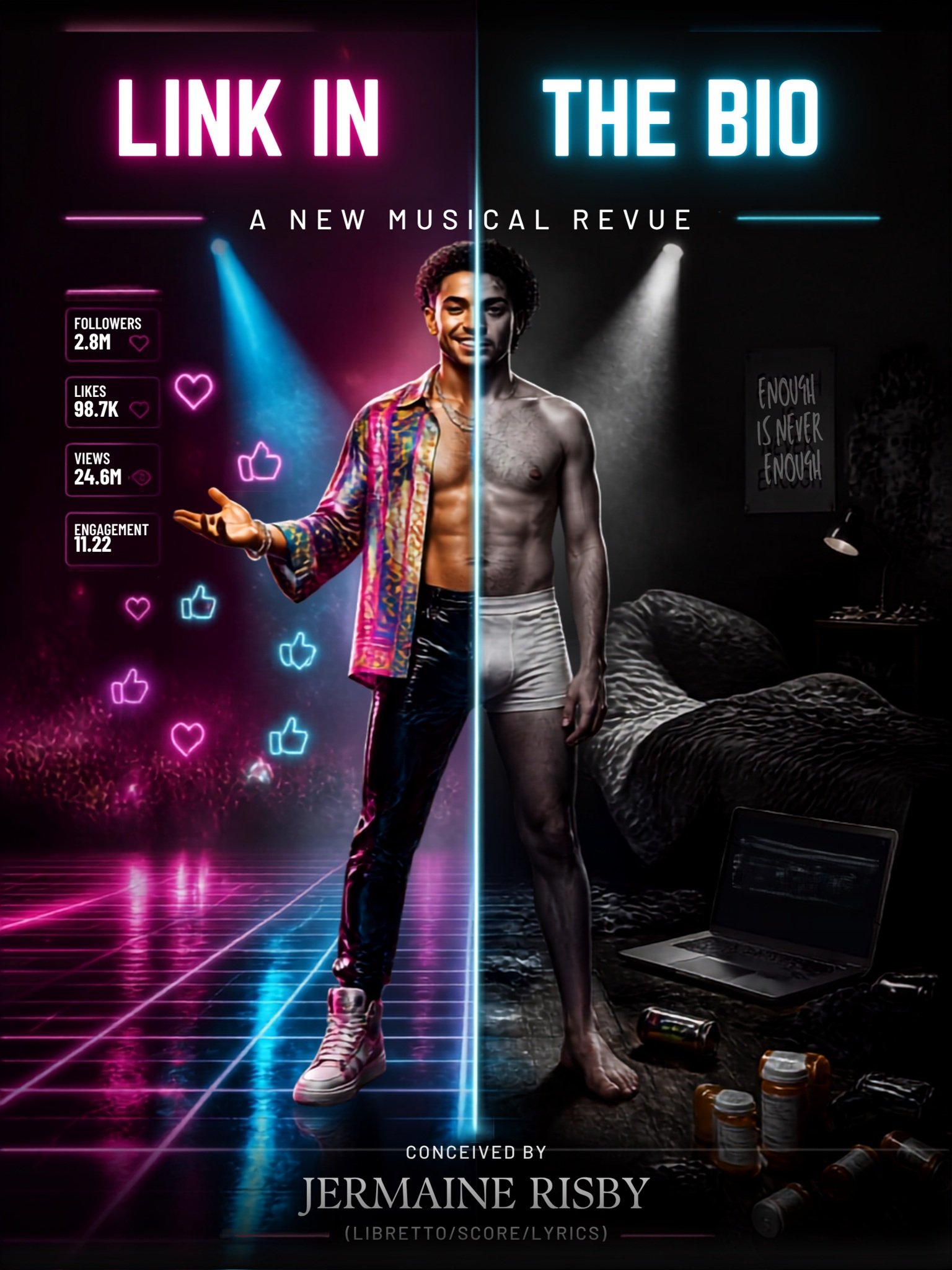
LINK IN THE BIO
Conceived by Jermaine Risby (Jay Rr)
Link in the Bio is a high-concept, non-linear musical revue designed to dismantle the digital "grid." Moving in a mosaic-style exploration, it provides a multifaceted dissection of labor, intimacy, and digital capitalism . By avoiding a traditional "rise and fall" plot, the revue mirrors the fragmented, high-speed nature of the internet itself .
Drawing explicitly from the structural DNA of Naked Boys Singing and the testimonial vulnerability of A Chorus Line, the production utilizes an "interview" aesthetic to peel back layers of digital performance . The show is calibrated to swing aggressively on a "Tone Pendulum" between high-camp satire of digital influencer culture and the sobering, visceral tragedy of systemic exploitation under modern subscription models .
Inspiration & DNA
Labor & Parasocial Intimacy: Grounded in the brutal socioeconomic data of platform monopolies , where top-tier creators capture the bulk of total revenue while the median creator lives on a modal revenue of $0.00/month . It exposes the human cost of turning the body into a 24/7 digital commodity, exploring the unsustainable emotional labor of scale-performing intimacy to ten thousand strangers .
Algorithmic Fatigue & Institutional Warfare: Inspired by investigative reports detailing the "stamina loop" of PnP/chemsex stimulants required to maintain a 24/7 camera-ready presence , alongside the invisible, systemic corporate warfare of creator deplatforming, "friendly fraud" chargebacks, and staggering 15% high-risk card processing fees .
The Narrative Structure
Act I: The Hypocritical Spotlight
Establishes the staccato, neon-drenched first impressions of the digital spotlight. It opens with "The DM Slide"—a satirical high-camp examination of influencer greetings—and progresses through the calculated, transactional social engineering of creator houses ("Let's Do A Collab") . We meet Leo, the metrics-obsessed Collab King , and explore the cold, confining glow of "Ring Light (My Only Friend)" . The act concludes with Thiago and Mateus in Brazil, highlighting the high-stakes game of international financial arbitrage .
Act II: The Transactional Toll & Act III: The Bare Reality
Pivots sharply to the systemic drains of the subscription economy. Julian navigates the commodification of empathy through rigid, automated chat scripts ("1-on-1 (Subscription Renewed)") , followed by the zero-recourse financial losses of friendly fraud ("The Chargeback Blues") and institutional credit-card deplatforming ("The Rules of the Card") . The show then descends into the drug-fueled algorithmic stamina loop ("Tina & The Algorithm") . Toby's story exposes the loss of personal agency and permanent digital leaks ("Behind the Paywall") , culminating in an acoustic-leaning, raw ensemble anthem ("Stripped") on reclaiming absolute human dignity once the ring light is finally extinguished .
ACT I: THE HYPOCRITICAL SPOTLIGHT
- Track 1: THE DM SLIDE
A staccato, neon-drenched high-camp satire of first digital impressions . - Track 2: LET'S DO A COLLAB
An ensemble piece capturing the calculated social engineering of creator houses . - Track 3: RING LIGHT (MY ONLY FRIEND)
A mid-tempo ballad about the cold, artificial glow that becomes a digital prison . - Track 4: USD TO BRL (GANHAR EM DÓLAR)
A high-energy Samba-pop track exploring financial arbitrage and funds lost in transit .
ACT II & III: THE TOLL & BARE REALITY
- Track 5: 1-ON-1 (SUBSCRIPTION RENEWED)
A dark, rhythmic exploration of automated chat-selling scripts and commodified empathy . - Track 6: THE CHARGEBACK BLUES
A gritty, rhythmic number exposing the zero-recourse drain of "Friendly Fraud" . - Track 7: THE RULES OF THE CARD
A wordy, rhythmic Sondheim-style patter song analyzing credit-card deplatforming and high-risk fees . - Track 8: TINA & THE ALGORITHM
A chaotic electronic descent depicting drug-fueled stamina loops and meth-psychosis . - Track 9: BEHIND THE PAYWALL (NO SCREENSHOTS)
Toby's haunting solo on the illusion of digital privacy and permanent non-consensual leaks . - Track 10: THE GHOST OF MY GRID
An eerie piece exploring digital afterlives and the trauma of permanent, un-fadeable footprints . - Track 11: STRIPPED
The acoustic finale, standing as a raw declaration to reclaim human dignity once the lights fade .
Note from the Writer
With Link in the Bio, I wanted to conduct a thorough socioeconomic autopsy of our modern attention economy . Adult platform creators are first and foremost laborers, yet they are subjected to brutal financial power-laws, predatory debanking, and algorithmic stamina loops that are fundamentally humanly unsustainable .
By choosing a non-linear mosaic structure, I wanted to replicate the rapid-fire, fragmented disorientation of the internet itself . The show is designed to swing aggressively between high-camp satirization of influencer glitz and the raw, visceral trauma of systemic exploitation, chemical dependency, and non-consensual leaks .
Ultimately, this show is not an act of voyeuristic exposure . It is a raw, acoustic human cry designed to reclaim human dignity from behind the cold paywalls of digital transactions, proving that the laborers behind these screens are human beings who demand to be heard .
* This show is still in development *